
For many patients and families, the first practical concern is the cost of knee replacement surgery. The answer is rarely one fixed number. Prices vary by procedure type, country, hospital, implant, rehabilitation plan, and insurance coverage. This guide summarizes publicly available data and explains how to interpret knee replacement surgery cost information before making a treatment decision.

When patients ask, “How much is a knee replacement?” public sources usually provide a range rather than a guaranteed price. The figures below are for reference only.
In the United States, studies show that the average cost of a knee replacement ranges from $15,000 to $75,000. This broad range shows why the cost of knee replacement surgery must be reviewed case by case.
Sidecar Health lists estimated average cash prices by state and separates outpatient hospital prices from surgery center prices. It also states that actual costs may be higher or lower, depending on the itemized bill and health plan details.
Professionals explain that total knee replacement surgery costs can be difficult to compare because bills may include facility charges, implant prices, rehabilitation, and post-hospital services. It also advises caution when comparing countries because medical standards, malpractice rules, and payment systems may differ.
The cost of knee replacement surgery depends on the procedure. Partial knee replacement treats one damaged part of the knee. Total knee replacement treats more extensive joint damage. Revision or complex knee replacement is usually more involved because it may require removing or replacing a previous implant.
Some research organizations note that partial knee replacement may cost 10% to 50% less than total knee replacement, while revision surgery is often the most expensive because of complexity.
Country, city, hospital, and facility type can all change the cost of knee replacement surgery. In the United States, costs may vary by region due to labor, rent, regulations, malpractice insurance, and local billing practices.
A surgery center may cost less than a hospital in some cases, especially for medically suitable outpatient procedures. However, patients with higher medical risk may need a hospital setting.
The surgical approach, implant selection, imaging, instruments, and disposable materials all affect the cost of knee replacement surgery. Some medical organizations note that many primary knee implants generally range from $3,000 to $10,000.
Technology can also change the cost structure. Robotic systems, navigation, or PSI, meaning patient-specific instrumentation, may affect planning, equipment use, guide production, and workflow. These options should be discussed with the surgeon based on anatomy, alignment goals, safety, accuracy, and recovery pathway, not price alone.
Explore more: Top 6 New Knee Replacement Surgery Techniques
The cost of knee replacement surgery does not end in the operating room. Patients may need pain medication, walking aids, imaging, follow-up visits, and physical therapy.
Patients may stay in the hospital for one to three days after knee replacement surgery. When skilled nursing care or inpatient rehabilitation is required, the overall cost can rise substantially. In comparison, outpatient physical therapy is often a lower-cost option.
Insurance coverage often decides how much a patient pays out of pocket. Many insurance plans, including Medicare and Medicaid, cover knee replacement when medically necessary, but patient responsibility depends on deductibles, copays, coinsurance, network rules, prior authorization, and other medical expenses in the plan year.
Cost control should never come before safety, surgeon experience, infection prevention, and appropriate rehabilitation. Still, patients can take practical steps to understand the cost of knee replacement surgery in advance.
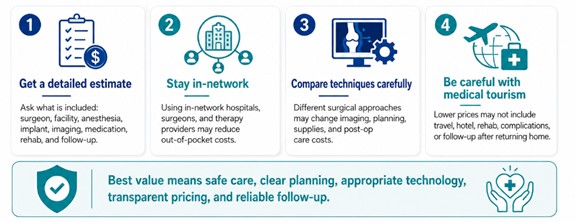
▶ First, ask for a detailed estimate before surgery. Clarify what is included: surgeon fee, facility fee, anesthesia, implant, imaging, medications, physical therapy, walking aids, and follow-up visits.
▶Second, stay within the insurance network when possible. In-network hospitals, surgeons, anesthesia groups, and therapy providers may reduce out-of-pocket expenses.
▶Third, understand how different surgical techniques may affect the overall process and cost structure. Different technical approaches may involve different preoperative imaging requirements, surgical planning methods, instrument preparation, consumable use, and postoperative management arrangements. As a result, they may also influence the overall cost composition.
▶Fourth, consider international or global medical tourism options with caution. Lower listed prices may not include travel, hotel stay, complications, rehabilitation, or follow-up care after returning home.
In short, value means safe care, clear planning, appropriate technology, transparent pricing, and reliable follow-up. The lowest price is not always the most responsible choice.
For patients considering PSI solutions or global treatment options, SunMoon helps international patients understand available treatment choices, expected care pathways, and key cost considerations before making a decision. We provide personalized solutions supported by a team with clinical experience.
Patients evaluating total knee replacement can visit our website or contact us directly to learn more about the treatment process, preoperative preparation, postoperative rehabilitation arrangements, and related cost information, helping support a clearer medical decision.