
Regaining independence is one of the first priorities after surgery, and driving is often at the top of that list. But driving too early after a knee replacement can create real safety risks. Braking, turning, and getting in and out of the car all depend on knee strength and mobility. This article explains how soon you can drive after knee replacement, what factors affect readiness, and why surgeon guidance matters.
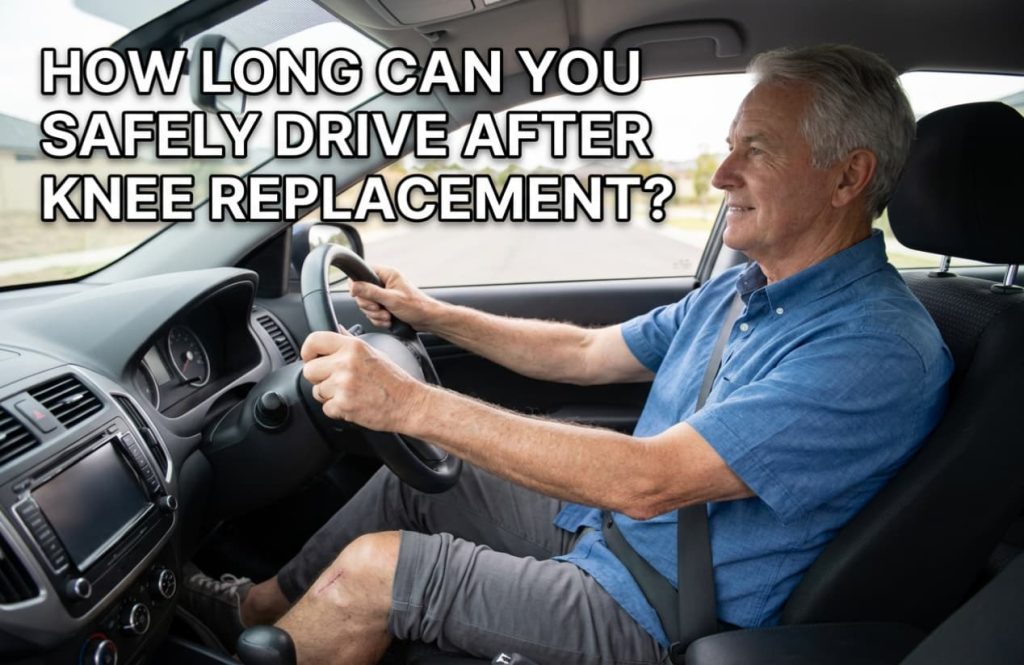
There is no fixed recovery date for returning to driving after knee replacement. Most patients resume driving after knee replacement within 4 to 6 weeks. Recovery is individual, and readiness depends on healing, strength, and pain control.
The side of knee surgery is one of the most important factors in driving after knee replacement.
➢ Right knee replacement: Usually requires a longer wait, typically at least 4 to 6 weeks, because the right leg controls the accelerator and brake pedals. Quick, forceful braking demands strength and coordination that take time to rebuild.
➢ Left knee replacement: Recovery is often faster. In an automatic vehicle, some patients are cleared as early as 2 to 3 weeks, since the left leg is not involved in braking or accelerating.
➢ Automatic vehicles: Automatic vehicles generally allow an earlier return, particularly after left knee surgery.
➢ Manual transmission vehicles: Manual vehicles require more time, often 4 to 6 weeks or longer regardless of which knee was replaced, since operating a clutch demands strength, coordination, and repeated knee flexion.
Several factors determine whether driving after knee replacement is safe:
The operated side is one of the most important factors in driving after knee replacement. Right knee replacement usually requires more caution because the right leg controls braking and acceleration. Left knee replacement may involve a shorter driving timeline for automatic-car drivers.
Pain and swelling can limit movement and slow reaction time. During the first weeks after surgery, swelling is common and may make it hard to bend the knee, move the foot quickly, or sit in the same position for extended periods.
If pressing the pedals causes sharp pain, stiffness, or delayed movement, the knee may not be ready for driving. You should also be able to get in and out of the car without pain or unsafe twisting.
Safe driving requires enough knee bend to sit comfortably and reach the pedals. Many patients need about 90 degrees of knee flexion for basic sitting and car entry, though the exact need may vary by vehicle and body size.
Knee strength also matters. The quadriceps and hamstrings help control the leg during braking and pedal movement. If the leg feels weak, unstable, or difficult to control, driving should wait.
Emergency braking is one of the most important safety tests. Even if daily walking feels acceptable, the knee may not yet be ready for a sudden brake response. Real-world driving includes traffic, distraction, road conditions, and unexpected stops.
You should not drive while taking opioid or narcotic pain medication. Drugs may cause sleepiness, slower reaction time, dizziness, and impaired judgment. This point is both medical and practical. Even if your knee feels stronger, driving under the influence of sedating pain medication is unsafe.
Practicing with the engine off, then starting in a quiet, low-traffic area, helps rebuild confidence before returning to regular driving after knee replacement.
Different types of knee replacement surgery can lead to different driving timelines.
| Surgery Type | General Driving Timeline | Main Reason |
| Total knee replacement | Often around 4 to 6 weeks | Full joint recovery, strength, braking control, and swelling reduction are needed |
| Partial knee replacement | May be earlier than total knee replacement for some patients | Less joint area is replaced, and some patients regain mobility sooner |
| Bilateral knee replacement | Often longer than single-knee surgery | Both legs need healing, strength rebuilding, and safe car entry and exit |
● Total knee replacement (TKR): As the most common procedure, TKR generally involves a recovery period of 4 to 6 weeks, with right-side surgery and manual transmissions on the longer end of that range.
● Partial knee replacement: Because only the damaged compartment of the knee is replaced, this less invasive procedure often allows a somewhat faster return to strength and mobility, which can shorten the recovery time.
● Bilateral knee replacement: When both knees are replaced, recovery tends to take longer overall. Without one stronger leg to rely on for pedal control or getting in and out of the car, the path back to driving after surgery is usually more gradual and depends on individual healing progress.
A Surgeon or care team can evaluate knee strength, range of motion, and reaction ability in person, offering guidance that is far more precise than a general estimate.
This assessment also matters for insurance and legal reasons, since driving before medical clearance may affect liability in the event of an accident.
SunMoon’s total knee replacement service supports patients across evaluation, treatment planning, surgery, and recovery guidance. If you have questions regarding the progress of your recovery, you can contact SunMoon for more information.
Q1: Is it different for right and left knee replacement?
R1: Yes. Right knee replacement usually requires a longer wait because the right leg operates the pedals. Left knee replacement, especially with an automatic vehicle, often allows an earlier return.
Q2: Can I drive while taking pain medication?
R2: No. Opioid or narcotic pain medications impair alertness and reaction time and should be fully discontinued before driving after knee replacement.
Q3: What should I test before driving again?
R3: Try sitting in a parked car with the engine off and practice pressing the pedals. This helps assess comfort, pain, and pedal control before attempting real driving.
Q4: What if driving causes knee pain?
R4: Stop driving and contact your care team if driving causes sharp pain, swelling, stiffness, or reduced control. Pain may mean the knee is not ready for that activity yet.
Q5: Can I take a long drive after knee replacement?
R5: Longer drives should wait until short trips feel comfortable and pain-free, and until a surgeon has confirmed full clearance.
Q6: Does the type of knee replacement affect driving time?
R6: Yes. Different types of knee replacement surgery can affect recovery. Partial knee replacement may allow earlier driving for some patients, whereas total and bilateral knee replacements often require more time.