
Pain behind knee, also called back of knee pain, is one of the more confusing symptoms people notice after knee surgery. Total knee replacement has a high success rate, yet knee pain after surgery still occurs in some patients.
This article explains what causes pain behind the knee, when it may be expected, and when medical review is needed.
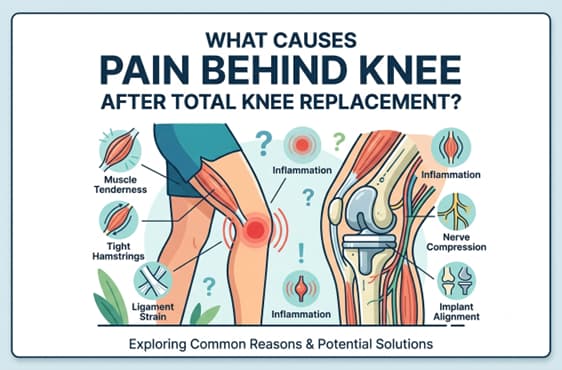
The area behind the knee, known medically as the popliteal region, is a compact space packed with important structures. It contains several important structures, including tendons, ligaments, nerves, blood vessels, joint capsule tissue, and the region where a Baker’s cyst may form.
Because this area is crowded with soft tissue and vascular structures, pain behind knee can feel different from pain at the front or side of the knee. Some patients describe it as tightness, pressure, pulling, burning, or a deep ache.
Front knee pain after surgery is often linked to the kneecap, incision area, or joint surface. In contrast, back-of-knee pain is more often related to swelling, tendon irritation, capsular tightness, nerve symptoms, or circulatory problems.
Recognizing this distinction helps patients and clinicians narrow down the common causes of knee pain in this specific location and guides how quickly a symptom should be evaluated.
Several mechanical, vascular, and neurological factors can contribute to pain behind knee after total knee replacement surgery.
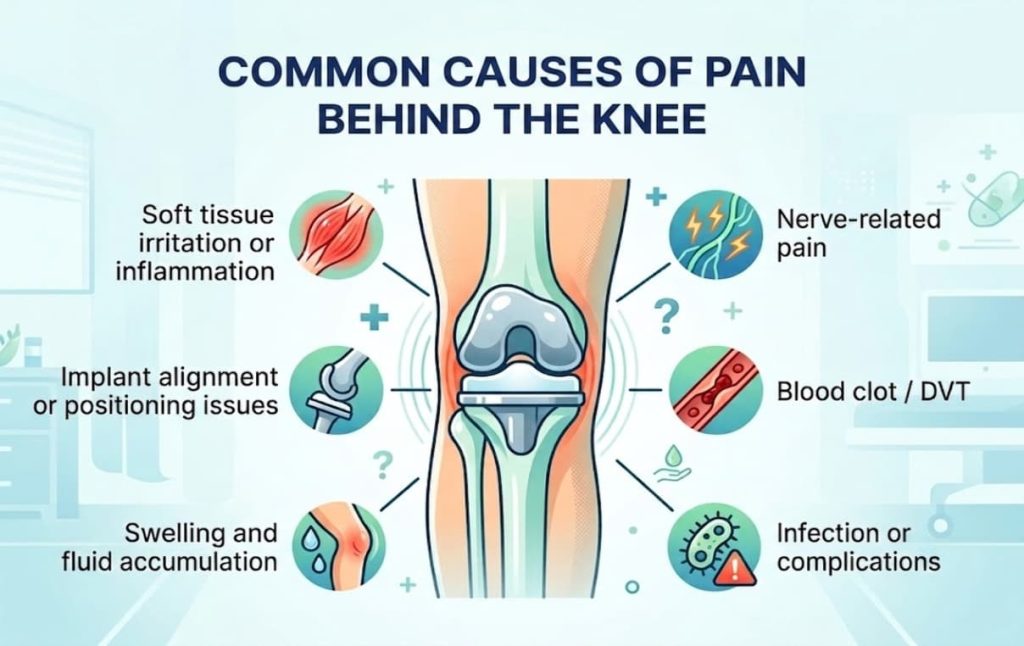
Soft tissue irritation is a common cause of knee pain after total knee replacement. During surgery and recovery, tendons, muscles, and scar tissue around the knee may become inflamed.
The popliteus and semimembranosus tendons can become irritated, leading to pain behind the knee, especially during bending or movement. Scar tissue buildup may also limit motion and cause tightness, a condition known as arthrofibrosis.
In addition, changes in walking patterns after surgery can strain the hamstrings or calves, contributing to discomfort at the back of the knee.
Component malpositioning can disrupt the joint’s normal mechanics, leading to uneven wear and abnormal stress on surrounding soft tissues.
Aseptic loosening, which occurs when the implant weakens at its connection with the bone, may also cause increasing pain or reduced function. In some cases, the joint may feel too tight or “overstuffed,” leading to pressure and discomfort at the back of the knee.
Swelling is common after knee replacement and can cause pressure and stiffness behind the knee. This is a common cause of pain behind the knee in early recovery and often improves with rest, elevation, and cold therapy.
A Baker’s cyst, a fluid-filled sac behind the knee, may also cause tightness or fullness. Sudden or severe swelling, especially with warmth or discoloration, should be evaluated by a doctor.
Nerve-related pain may feel sharp, burning, or tingling. It can occur when nerves around the knee become irritated during healing. The common peroneal nerve may be affected, causing pain, numbness, or weakness around the knee or lower leg.
Deep vein thrombosis(DVT) is a serious complication that can cause pain, tenderness, swelling, warmth, or redness in the calf or behind the knee.
Risk is higher with prolonged immobility, obesity, and older age. This symptom pattern requires prompt medical evaluation rather than home management.
Infection is uncommon but important to rule out. Signs include increasing pain, fever, redness, warmth, or wound drainage.
Other causes may include ligament strain or scar tissue. Patients should seek medical advice if pain is severe, persistent, or unusual.
| Description | Common Methods | When It Is Considered | |
| Conservative Treatments | Basic care to reduce swelling and restore motion | Medication, icing, elevation, compression, physical therapy | Early recovery or mild symptoms |
| Minimally Invasive Approaches | Targeted treatments if basic care is not enough | Injections, cyst drainage, arthroscopy, nerve treatments | Ongoing pain or stiffness not improving with basic care |
| Regenerative Therapies | Support tissue healing in selected cases | Platelet-rich plasma (PRP), selected cell-based therapies | Soft tissue pain after proper evaluation |
| Revision Surgery | Surgery to fix structural problems | Implant adjustment or replacement, correction of alignment, treatment of infection | Serious issues like implant problems or infection |
● Conservative treatments
Conservative treatment is usually the first step and focuses on reducing swelling, protecting healing tissues, and restoring movement. This may include medications, icing, elevation, compression, and guided physical therapy to improve strength and flexibility.
● Minimally invasive approaches
If symptoms persist, this approach may be used based on the underlying cause. These can include manipulation under anesthesia for stiffness, injections for inflammation or nerve pain, and addressing specific tissue problems.
● Regenerative therapies
Regenerative treatments aim to support tissue healing and reduce inflammation. Options such as platelet-rich plasma or stem cell-based therapies may be considered in selected cases, depending on the patient’s condition and overall health.
● Revision surgery
Revision surgery is considered when a clear structural issue is identified, such as implant problems, instability, or infection. This option is typically reserved for cases where other treatments are ineffective or inappropriate.
For patients dealing with knee pain after total knee replacement surgery, both the surgical approach and post-operative support matter. SunMoon provides joint care and total knee replacement support, focusing on identifying the cause of knee pain and offering personalized treatment.
If you are experiencing pain behind the knee after total knee replacement, our specialists can help you better understand your symptoms and explore suitable treatment options. Contact SunMoon to schedule a personalized evaluation.