
Amyotrophic Lateral Sclerosis (ALS) is a progressive neurologic disease affecting the motor neurons, the nerve cells that help the movement of muscles. Knowledge of the 7 stages of ALS will help the patient and the family be prepared for each phase of the illness. Available treatments for ALS are also discussed;
these include emerging therapies such as stem cell treatment.
What Is Amyotrophic Lateral Sclerosis (ALS)?
ALS is a progressive neurodegenerative disease, otherwise known as Lou Gehrig's disease, characterized by loss of muscular control. This results from the degeneration and death of motor neurons within the brain in such a way that muscles do not receive signals.
Causes:
Primary Symptoms:
It does not normally affect memory or intellect but has a deep impact on mobility and quality of life.
What are the 7 stages of ALS?
To monitor the progression of ALS, the King's staging system was developed.
The King's staging system includes five major stages[1,2,3], which can be further subdivided into seven finer sub-stages to detail disease progression:
| Stages of ALS | Symptoms | Impact on Daily Life |
| Stage 1-Symptom onset with involvement of the first region | Symptoms are usually mild and subtle, confined to one region of the body. They may present with difficulty with fine motor tasks, trouble gripping objects, balance problems, or a tendency to trip easily (limb onset). Alternatively, they may manifest as speech articulation difficulties, voice changes, trouble swallowing, and chewing (bulbar onset). Other early signs include muscle stiffness, twitching, spasticity, abnormal fatigue, and the onset of muscle atrophy. | Despite these symptoms, most patients can still maintain a high level of functionality and independence. |
| Stage 2A-Diagnosis | Formal diagnosis stage. Symptoms become more noticeable and may spread to additional regions. Muscle weakness intensifies, affecting grip strength and balance. Speech articulation and swallowing difficulties may become more pronounced. Breathing problems may begin to appear, especially when lying down. | Many patients still maintain a high degree of functionality and independence but may require assistance with certain daily activities. |
| Stage 2B-Involvement of the second region | Symptoms spread to a second body region, marking significant disease progression. Muscle weakness becomes more pronounced, affecting a broader range of bodily functions. A combination of limb and bulbar symptoms may occur. | Major impact on daily activities and independence. Patients may begin to need walking aids such as a walker or wheelchair. Environmental modifications and assistive equipment are required to maintain independence. |
| Stage 3-Involvement of the third region | Both limb and bulbar symptoms continue to progress. Fine motor tasks such as buttoning clothes or grasping objects become difficult. Balance issues worsen, leading to frequent tripping. Weakness of the swallowing muscles may cause choking hazards and difficulty managing saliva. | Increasingly significant impact on daily activities and independence. Patients typically already require assistive devices and generally stop driving. Adaptation of the living environment and assistive technologies becomes necessary. |
| Stage 4A-Need for gastrostomy | Swallowing difficulties worsen, leading to the need to manage saliva and prevent potential choking hazards. Respiratory difficulties may occur, especially when lying flat. | Further decline in independence. Nutritional intake may require the use of a feeding tube. Noninvasive ventilation support may be needed to manage breathing difficulties. |
| Stage 4B-Need for noninvasive ventilation | Generalized paralysis with near-total loss of voluntary muscle control, requiring continuous respiratory support. | The patient becomes completely dependent on caregivers. Full reliance on a feeding tube and permanent mechanical ventilation. The primary focus of medical care is maximizing patient comfort, including pain management, anxiety relief, and palliative (end-of-life) care. |
| Stage 5-Death | / | / |
Knowing what the 7 stages of ALS are can help in making one understand how this neurological disorder's progression and care can be planned.
Additionally, there is the MiToS system for ALS clinical staging, which uses a different staging method.
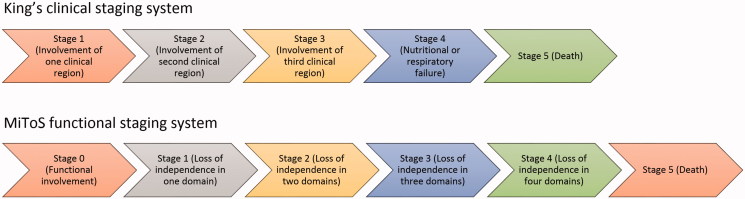
Figure. Flowchart of ALS staging systems and their definitions (King’s staging and MiToS staging).
*The figure is adapted from Fang et al. (2017), "Comparison of the King’s and MiToS staging systems for ALS" (PMCID: PMC5425622), which is an open-access article published under the CC‑BY 4.0 license.
Stem Cell Therapy and ALS
Stem cell therapy is a new frontier in treating neurological diseases like ALS, wherein undifferentiated cells, capable of differentiating into either nerve or muscle cells, are employed to either repair or replace damaged motor neurons.
Therapeutic Mechanisms:
Although some researchers around the world are conducting clinical trials related to ALS using stem cell therapy, with safety and effectiveness in consideration, early results suggest improvement in muscle strength and respiratory functions, but further studies are still ongoing.
SunMoon’s Expertise in Stem Cell Application
SunMoon stem cells reflect modern approaches with a background of medical expertise and clinical research for ALS patients who seek advanced options.
Why SunMoon?
Although the question of whether or not the stem cell therapy cures ALS remains under scientific investigation, early results are indeed very encouraging. Though the stem cells themselves may not completely reverse the disease, they can have the potential to slow disease progression, preserve remaining function, and improve life quality. SunMoon continuously contributes to this growing field through continuous research and compassionate patient care.
Conclusion
ALS is a terrible neurodegenerative disease; it gradually takes away one's ability to move, speak, and even breathe. Being able to understand the 7 stages of ALS will definitely help both the patients and the caregivers prepare for the changes accordingly. Though there is no cure as yet, new developments in the treatment options so far available for ALS, including medication, physical therapy, and stem cell therapy, raise hope for slowing down the progress and improving the quality of life.
References:


Interested in stem cell therapy? Contact us for a free consultation with our medical experts.
Schedule Now Appointment
 Online Communication