
Kneeling is an important movement in daily life. People kneel when gardening, cleaning floors, playing with children, praying, exercising, or getting up from the ground.
Yet for patients who have undergone knee replacement surgery, this seemingly simple action often becomes uncertainty. Many worry that kneeling might damage the prosthetic implant or cause premature wear. These fears are understandable.
This article aims to explain why you feel difficult to kneel after knee replacement, when it is appropriate to kneel, and practical rehabilitation strategies.
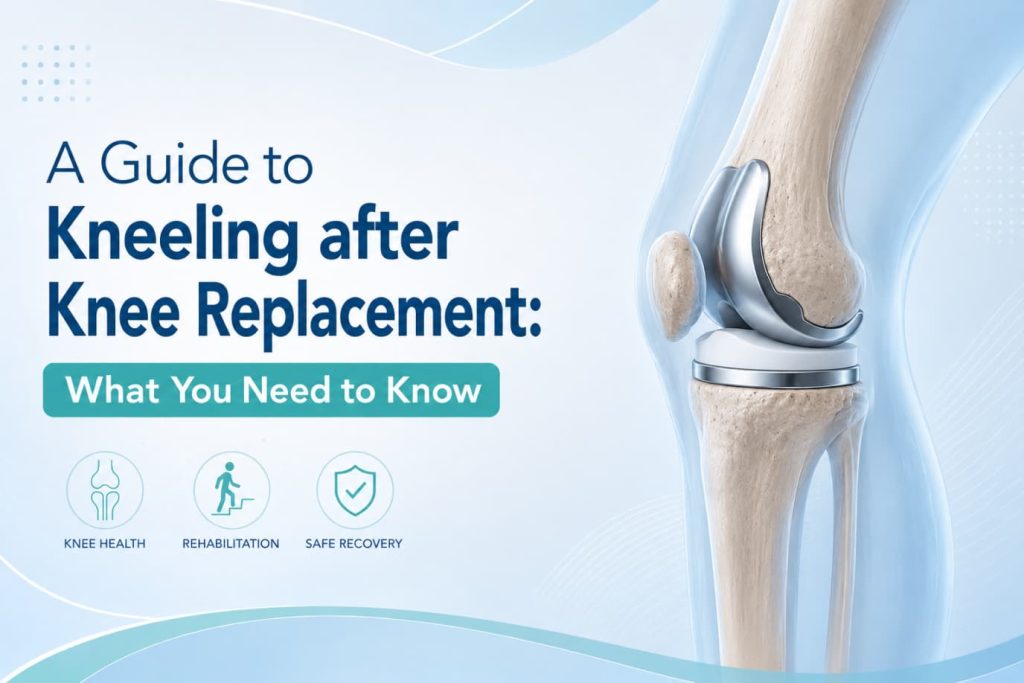
Kneeling after knee replacement can feel uncomfortable for several reasons. The difficulty usually comes from changes in the skin, soft tissue, sensation, and movement patterns.
Your surgical incision heals by forming scar tissue. This tissue is less flexible than normal skin and can feel tight, thick, or painful when stretched tightly over the kneecap during kneeling.
Some small skin nerves may be affected during surgery. This can lead to a numb patch around the incision. Numbness does not always mean something is wrong, but it can make kneeling feel unfamiliar. A patient may feel pressure in an uneven way, which makes the movement less natural.
The kneecap area experiences direct contact when kneeling. After knee replacement, some patients describe pressure, tingling, burning, or a strange sensation when the knee touches the ground.
Successful kneeling requires sufficient knee flexion. If the knee remains stiff after surgery, lowering the body toward the ground can feel difficult.
Rehabilitation exercises focus on improving:
● Knee bending ability
● Quadriceps strength
● Balance and stability
● Confidence with daily movements
A patient with good walking ability may still need additional time before feeling comfortable kneeling.
Fear is another major factor affecting kneeling after knee replacement. Many patients worry that putting weight on the knee will loosen or damage the implant.
Modern knee implants are designed to support normal daily activities. However, hesitation can prevent patients from gradually rebuilding confidence.
Proper guided practice can help patients understand which movements are safe and how to approach kneeling correctly.
There is no single answer to “when can you kneel after knee replacement?” Recovery depends on healing speed, pain level, muscle strength, and flexibility.
Explore more about the recovery: How Long Does Recovery Take After Total Knee Replacement?
Before attempting kneeling, patients should wait until:
Patients should not kneel while the incision is still open, scabbed, draining, infected, or very tender. Direct pressure on an unhealed wound can increase irritation and may raise the risk of wound problems.
Even when the skin looks closed, the deeper tissues are still adapting. Muscles, tendons, joint capsule tissue, and surrounding soft tissue need time to tolerate pressure and bending. Trying to kneel too soon may not damage the implant, but it can increase pain and make the patient more afraid to try again later.
A patient needs enough quadriceps strength, hip strength, and balance to lower the body safely. The patient also needs enough knee bending to enter the position without twisting or falling. Early recovery usually focuses on walking, swelling control, knee extension, knee flexion, and functional strength before deep kneeling practice.
To kneel safely and comfortably following knee replacement surgery, it is essential to adopt proper techniques that protect your new joint and build confidence gradually:
● Use adequate padding: Always place a thick cushion, a specialized kneeling pad, or a folded towel beneath your knee. This significantly reduces direct pressure on the implant site and minimizes discomfort.
● Lower yourself slowly with support: Never drop suddenly onto your knees. Instead, use a stable chair, handrail, or countertop to control your descent. This allows you to ease into the kneeling position gradually and maintain balance throughout the movement.
● Place your non-surgical knee down first: When kneeling, always put the knee on your unoperated side down before the surgical one. This reduces the initial load on your replaced joint and gives you better control over the movement.
● Start on softer surfaces: Begin practicing on forgiving ground such as carpeted floors or yoga mats. These surfaces absorb more impact and allow you to test your comfort level before transitioning to harder floors.
SunMoon specializes in advanced knee rehabilitation resources and expert guidance. We offer a structured pathway that includes online consultation, personalized evaluation, expert surgery, rehabilitation, and long-term follow-up. We cooperate with Dr. Yang Bin and the Peking University International Orthopedics Team, using CT/MRI-based 3D reconstruction and AI-assisted planning to support more precise knee replacement planning.
We understand that recovering your mobility involves overcoming both physical barriers and psychological hesitation. Every knee journey is unique, and general timelines may not fit your specific surgical recovery.
Contact SunMoon for personalized advice about knee replacement surgery.