
Severe knee osteoarthritis can make walking, standing, and daily movement increasingly difficult. Total knee arthroplasty, also called total knee replacement, is a well-established treatment when non-surgical care no longer provides enough relief. Within current knee replacement technology, two planning approaches often discussed are PSI and robotic assistance.
This article explains what PSI means, how robotic total knee replacement works, where the two pathways differ in practice, and which factors matter beyond the tool itself.

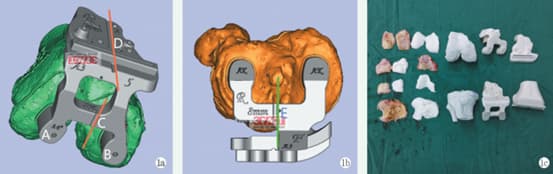
1a: Three-dimensional model of the modified patient-specific instrumentation (PSI) individualized guide for the femoral side; 1b: Three-dimensional model of the modified PSI individualized guide for the tibial side; 1c: Comparative image of the 3D-printed modified PSI individualized guide intraoperative error calibration auxiliary tool (white) and the actual surgical osteotomy bone fragment (bone color)
PSI, or patient-specific instrumentation, is a method used in total knee arthroplasty to support preoperative planning and bone resection. In a typical PSI workflow, CT or MRI data are used to build a three-dimensional model of the patient’s knee, and custom surgical guides are produced to match that anatomy.
For the patient, the PSI knee replacement process usually starts before surgery with imaging and planning. The surgical team reviews the anatomy, confirms the operative plan, and then uses the patient-specific guides during surgery to position cuts according to that preoperative plan.
In practical terms, PSI may reduce the number of standard instrument trays and can fit more easily into routine operating room workflows because it does not require a robotic platform in the hospital. At the same time, PSI depends on imaging quality, preoperative planning, and accurate guide fit at the time of surgery, so surgeons may still need to make intraoperative adjustments when needed.
Robotic knee replacement refers to robotic-assisted total knee replacement, in which the surgeon uses a robotic system to support planning and bone preparation during surgery. The surgeon remains in control, while the system helps guide execution through preoperative planning, intraoperative registration, and software-defined boundaries for bone resection.
In a robotic-assisted total knee replacement workflow, imaging or image-free mapping is used to create a surgical plan, depending on the platform. During surgery, the system registers the patient’s anatomy, and the robotic tool helps the surgeon carry out the planned cuts within the allowed boundaries.
This type of knee replacement technology usually requires dedicated equipment, trained staff, and a hospital that already supports robotic infrastructure. Because of those requirements, robotic total knee replacement is often concentrated in centers that have invested in the platform and the associated training pathway.
The most useful comparison between PSI knee replacement and robotic total knee replacement is often not a simple performance claim.
In many real clinical settings, the clearer differences are planning method, operating room workflow, infrastructure needs, cost structure, hospital accessibility, and learning curve.
| Aspect | PSI | Robotic knee replacement |
| Planning | Based on preoperative CT or MRI and patient-specific guides. | Based on platform planning plus intraoperative registration or mapping. |
| Workflow | Custom guides are prepared before surgery and used during manual execution of the procedure. | The surgeon uses a robotic system during surgery to guide planned resections. |
| Infrastructure | No robotic unit is required in the operating room. | Requires a robotic platform, setup, maintenance, and trained support staff. |
| Cost | Typically includes imaging and custom guide production costs. | Usually involves higher capital and per-case costs because of the platform and service model. |
| Hospital accessibility | Can be more feasible in hospitals that do not have robotics programs. | More limited to hospitals and centers with robotic capability. |
| Learning curve | Often closer to established manual TKA workflows for teams already familiar with them. | Usually requires additional training and a platform-specific learning curve. |
▶PSI may be a practical option when a hospital wants a more personalized workflow without installing robotic hardware, or when surgeons want to integrate patient-specific planning into an existing total knee arthroplasty pathway. It may also be relevant for centers where operating room logistics, tray reduction, or infrastructure limits are important considerations.
▶Robotic total knee replacement may fit hospitals that already have a robotic platform, dedicated training, and a team comfortable with that workflow. It may also appeal in environments where the surgical team wants intraoperative digital feedback as part of planning and execution.
▶For patients, the most appropriate choice is often not determined by a single label, such as PSI knee replacement or robotic-assisted total knee replacement. It depends on the surgeon’s familiarity with the method, the patient’s anatomy and deformity pattern, the hospital setting, and how the full perioperative plan is organized.
The tool matters, but it is only one part of successful total knee arthroplasty. Surgeon experience, appropriate case selection, implant strategy, soft-tissue management, and postoperative rehabilitation remain central factors in outcomes after total knee replacement.
This is especially important when discussing future knee replacement technology. New tools may continue to expand planning precision and workflow options, but the core clinical questions remain consistent: whether the indication is appropriate, whether the operative plan matches the patient, and whether rehabilitation is well managed after surgery.
SunMoon is a global high-end medical service platform that integrates advanced medical technologies with expert resources to provide advanced treatment solutions, including personalized PSI total knee replacement. With extensive experience in preoperative planning and cross-border medical coordination, SunMoon is able to accurately match patient needs with appropriate surgical pathways, hospitals, and specialist teams, improving overall treatment quality and efficiency.

What is the Main Difference between PSI and Robotic TKA?
PSI uses preoperative imaging to create custom cutting guides delivered before surgery. Robotic-assisted total knee replacement uses a robotic arm with real-time intraoperative navigation for bone resection.
Is PSI as Accurate as Robotic Surgery?
Recovery speed is influenced by multiple factors, including patient age, health status, and surgical experience. Some studies indicate that long-term recovery outcomes (such as 3 months to 1 year) may show no significant difference between the two.
Is PSI as Accurate as Robotic Surgery?
Research on the accuracy comparison between PSI and robotic surgery presents different perspectives. Some studies show no significant difference in postoperative clinical functional outcomes between the two approaches.
Can PSI be Performed in Smaller Hospitals?
PSI has a relatively lower equipment threshold and does not require expensive robotic systems (which typically require millions of dollars in investment), making it potentially more feasible in smaller hospitals with limited resources. However, PSI still requires preoperative imaging and a customized instrument production process, so hospitals need to have appropriate imaging equipment and supply chain coordination capabilities.
How do costs compare between PSI and robotic TKA?
There are differences in cost structure between the two. Robotic systems require equipment investment at the million-dollar level, plus $800–1000 in consumables per case (data for reference only); PSI systems do not require large equipment investment or maintenance, primarily relying on 3D printing and AI planning, with a cost of approximately 500 Chinese yuan per case, and can be directly integrated into existing surgical systems. Specific cost differences are influenced by factors such as hospital surgical volume, regional pricing standards, and equipment usage frequency.